
✌️ Hey, I’m Caitlin. I help product, design, and insights folks do better customer research with AI—without the hype.

It’s one of the final days to join my next Claude Code for Customer Insights cohort on Maven. It’s a Maven Top 100 course, rated ✦ 4.8/5 (ratings keep going up!) — and I just made some pretty good updates for this run, if I do say so myself.
The first agent I created that finally did things right took me a week. The third one: three hours.
You read all this advice that says you need agents for everything, and here’s how to set them up and they make it sound so easy, but they forget something: you need to improve them, and that’s hard.
I have yet to meet anyone who has created an agent from scratch that was truly the perfect hire from day one. The non-human employee that never needed feedback about how they communicate or a fully revised SOP after one month. It doesn’t exist!
My first agent took me a week because I painstakingly hand-wrote half of the instructions. I copied my own reliable SOPs for analyzing customer calls from different teammates with different levels of interview skills, and added rules about how to handle them.
Then I ran it.
I’d written prescriptions for cases and failure modes that hadn’t even come up after feeding it 45 transcripts. The failure modes that did come up hadn’t been solved. The instructions ended up being about half as long with a better coverage of the right failure modes. I couldn’t have figured that out from day 1.
I kept giving my agent feedback and fixing things by hand, transcript after transcript. We spent a lot of time together.
Finally the agent was a master at handling all kinds of interviews, from all kinds of people playing interviewer.
The second time I improved an agent…I made all the same mistakes! The third time, I learned about self-improving feedback loops. I did everything differently, and the results were just as good (but faster).
After many more agents, I finally accepted that iterating to a high performing agent does not depend on me sitting at my laptop and constantly correcting it myself. With the right set of information, an agent can do that without me.
“But Caitlin, this topic is way over my head!”
The idea of setting up agents that have their own ways to self-improve probably sounds like a lot to some of you - beyond where you are with AI today, what you feel technically capable of. Far beyond what you have the bonus headspace for on Friday evenings. I want to get you running your first simple self-improvement loop today, possibly within 10 minutes (yes, really).
In this edition:
🎒 Set it up — four files, already written. Copy them, run one command, and watch your agent catch itself. ≈ Ten minutes
🗺️ What’s actually in a loop, and who decides it got better? — the three parts, and the essential thing an agent can’t do for itself
⚠️ Troubleshooting ahead — the ten-second test that would have saved me a day
What you’ll need, before you get your loop going:
An AI tool that works with files on your machine — Claude Code, Codex, or similar. Not the chat window in a browser. This whole thing runs on files sitting in folders, and a chat tab can’t reach them the same way.
Mac, ideally. One of the four files is a shell script. Windows needs WSL, and I haven’t tested it there.
3+ interview transcripts you don’t mind experimenting on. Wherever they already live is fine. You’ll copy the file path.
A consistent way of labeling who’s speaking. The setup assumes
P01,P02and so on, in the file and in the filename. If yours sayInterviewer:or use names, that’s one line to change in one file — and the first thing you run will tell you exactly which line, before you waste a run on it (see below in THE ROUTE)
If you’re using something other than Claude, everything here still works, you’ll just swap a couple of folder names in the instructions for whatever your tool calls them.
🗺️ THE ROUTE
Your agent + a starter self-improvement loop
You’re setting up an agent that checks its own work before it hands it to you, and keeps a record of what it got wrong. That’s how it can improve over time.
I will start by acknowledging that creating self-improvement loops is complicated. There’s a lot to get right.
So what I’ve set up for you here today is an attempt to get you using and playing around with one self-improvement loop and understanding what the pieces are that are built in. I want to get you past the fear of this type of tool.
Your job is to run this simple process as I’ve built it for you, look at what it catches, and open the files up if you want to see how the pieces work.
It takes three steps and ≈10-15 minutes.
Step 1 — Download the four files
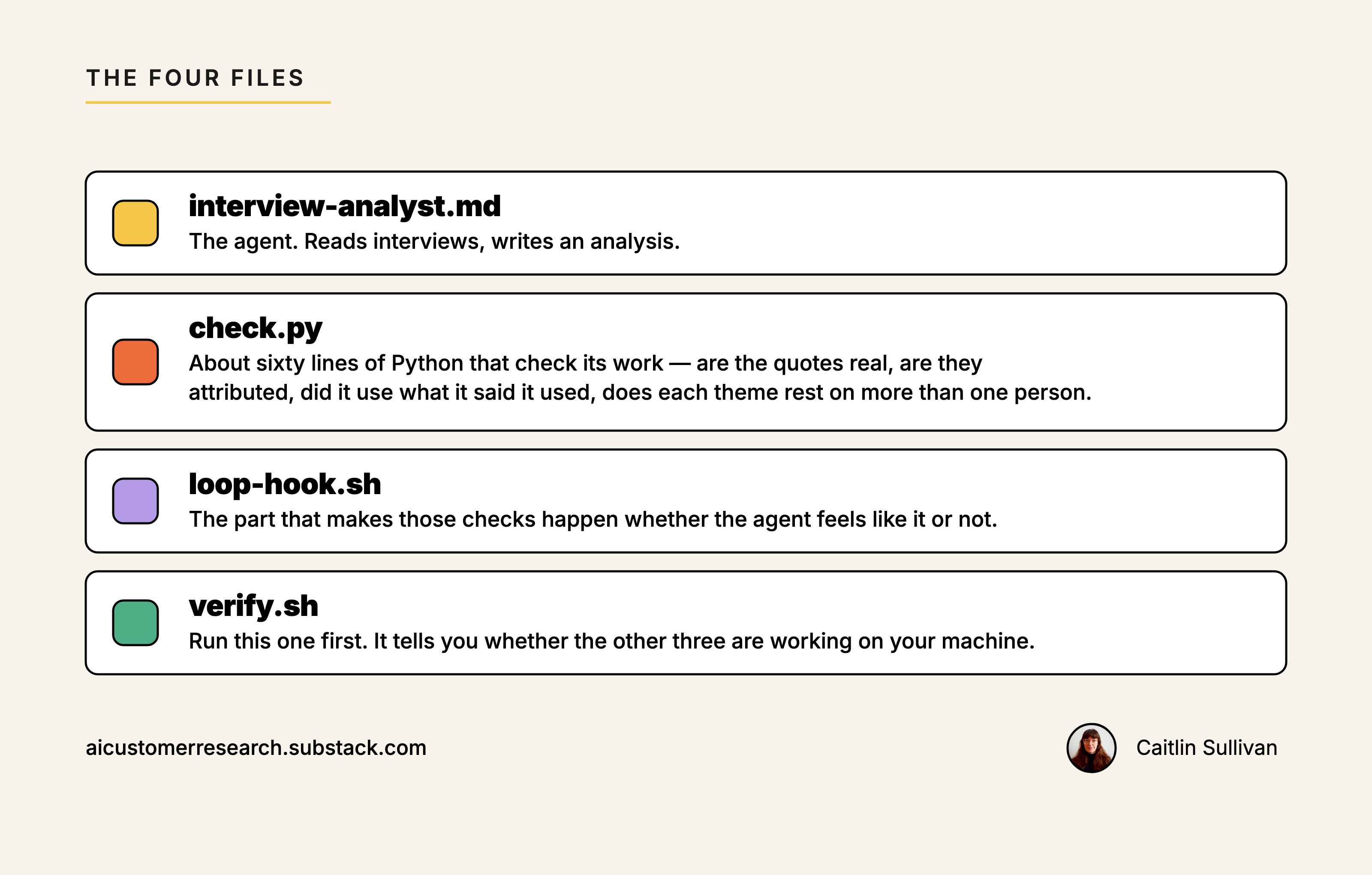
Put them wherever you like. A folder on your Desktop is fine.
—
Step 2 — Have Claude set them up
You don’t have to install any of it yourself. Download the four files, then paste this into Claude Code — or Codex, or whatever similar tool you use — filling in the two paths (ex: “PATH-TO-MY-INTERVIEW-TRANSCRIPTS” should not remain like that).
I've downloaded four files into FOLDER-YOU-PUT-THEM-IN.
Set them up for me. Don't rewrite any of them.

1. Copy interview-analyst.md into ~/.claude/agents/ so Claude can find it.
   Leave the other three where they are.

2. Run this and show me exactly what it prints, line for line:
      ./verify.sh "PATH-TO-MY-INTERVIEW-TRANSCRIPTS"

3. If anything comes back NO, tell me what needs changing and wait.
   Don't change it yourself without asking me first.

4. If it all passes, say so and stop there.
That second path is just the folder you already have some interviews in. Nothing needs moving or renaming for this.
What’s this verify.sh file? It breaks things on purpose in a temporary folder, checks that the loop notices, cleans up after itself, and tells you either “your loop is working” or exactly which line to change. It never touches your real files.
—
Step 3 — Ask for an analysis
You’ll just write the agent’s name, like interview-analyst in the prompt, then tell it your request. ”Look for why users cancelled in interviews P02, P03 and P05,” or whatever your test request is. My long request below is just me copying direct file paths for my three interviews (you can also just name them), then I asked:
“What caused cancellations, and where was value fragile?”
(There was no fancy prompting here, just a simple ask).
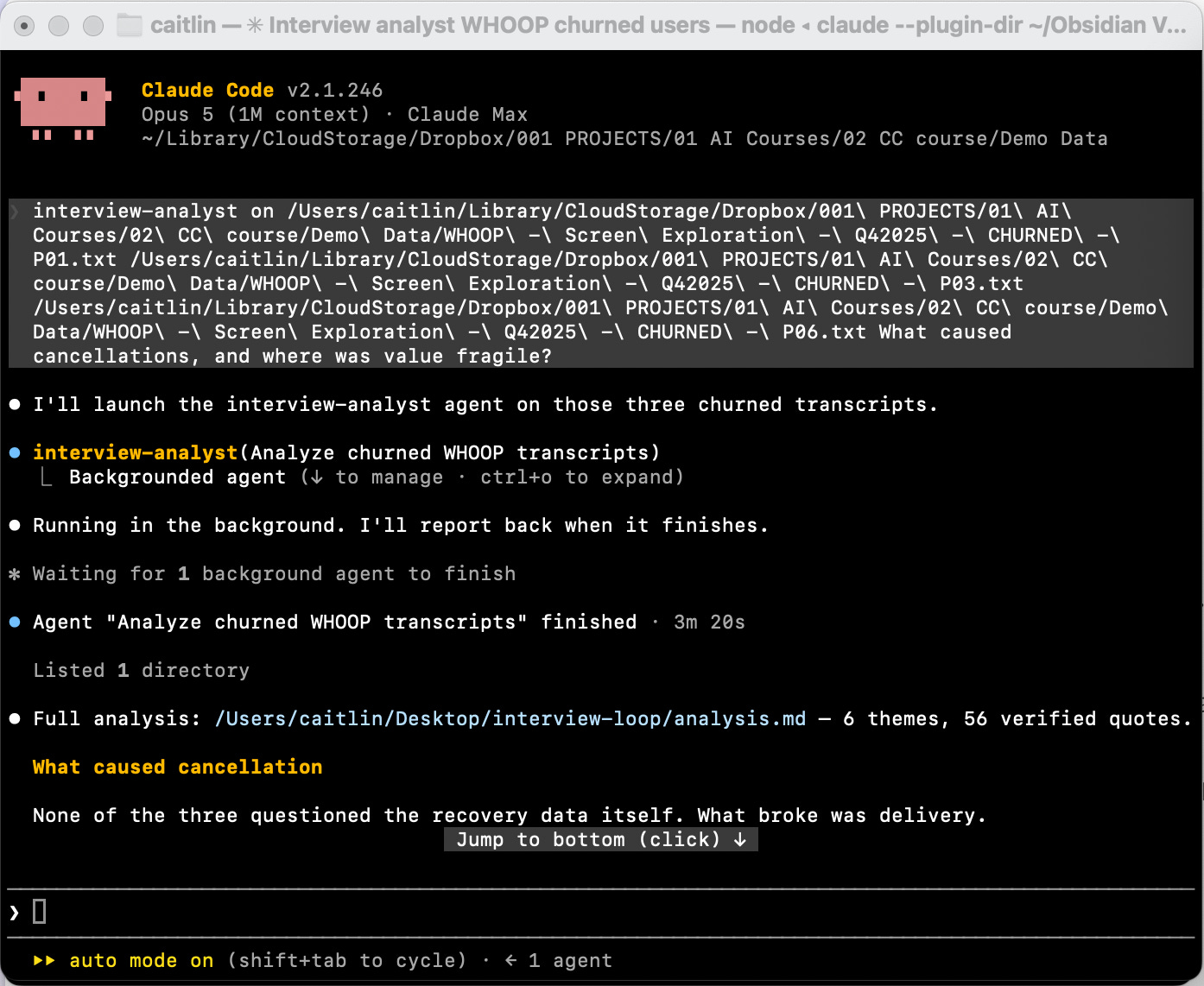
Two more files will be created on their own in the folder for this. They will be created the first time the agent runs, and then reused in every run:
interview-analyst.md   ← the four you downloaded
check.py
loop-hook.sh
verify.sh

loop-log.md            ← these two get written for you
loop-trail.log
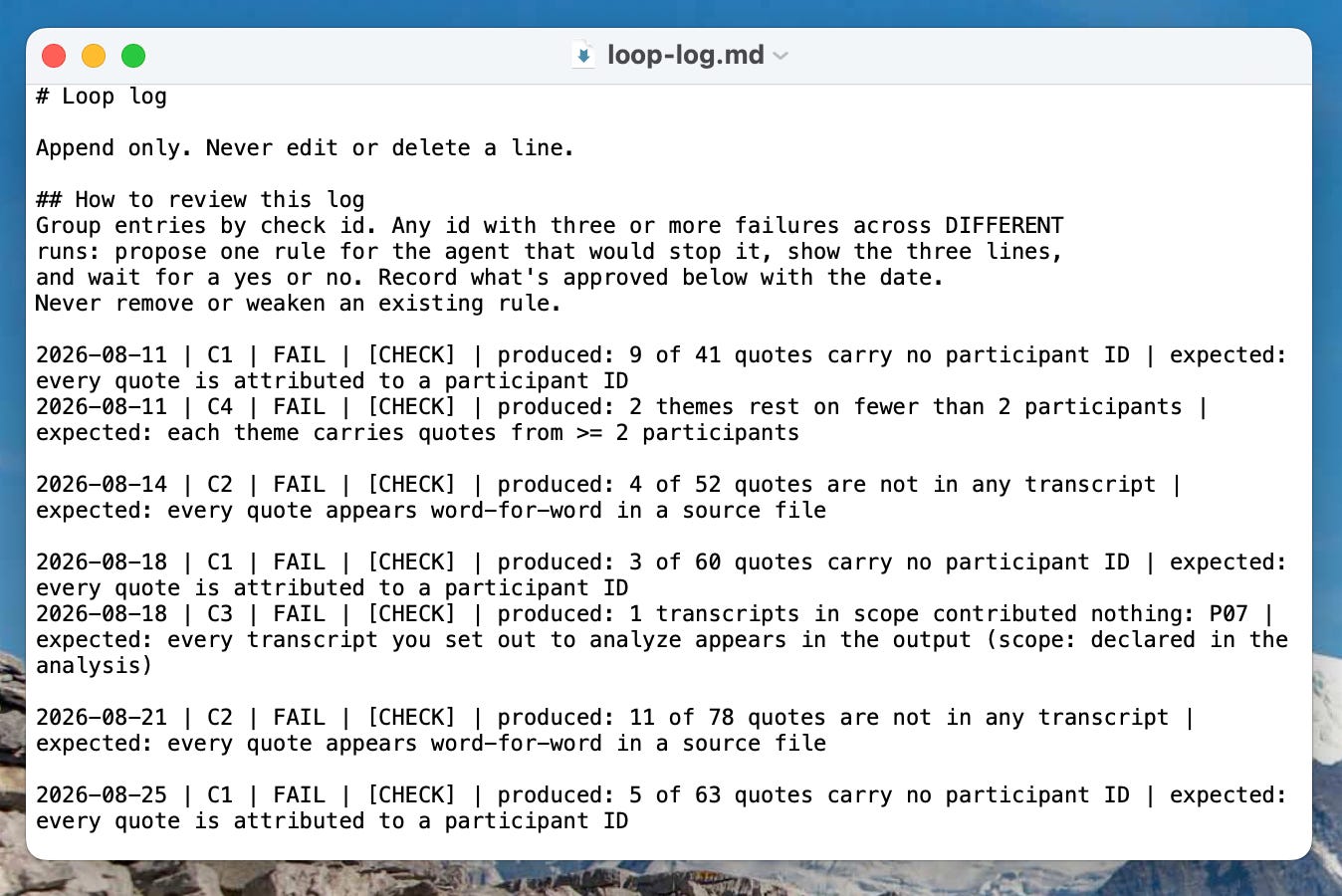
loop-log.md is what went wrong, over time. loop-trail.log is what the hook decided, run by run (the hook being the bit that won’t let the agent finish without checking its work). They’re the memory. If your folder still has only four files after a run, that’s your first sign something didn’t work the way it should.
Watch the agent run. The interview-analyst agent writes the analysis. And before it can hand that to you, its work gets checked. Anything that failed comes back as a list, it fixes its own output, and tries again. You might see “running check.py” come up at the bottom of the terminal window where status is displayed.
When I first ran this on three real interviews, eleven of its seventy-eight quotes weren’t word-for-word. It caught all eleven, fixed them in about a minute, and handed me the corrected version. I’d never have known — and a reworded quote is exactly the thing that ends up in a client deck.
The four checks are “true or false” questions
The four checks it runs through are four questions with true-or-false answers (that’s important for simplicity here):
Does every quote actually appear, word for word, in a transcript?
Is every quote attributed to a participant?
Did every transcript it said it read actually get used?
Does every theme rest on more than one person?
None of those checks need your “opinion”, or anyone else’s. They are things that can be checked, even without a strong reasoning model. The quotes match letter for letter, or they don’t.
On clean runs (no errors) and checking that the loop works
One thing to expect: your first run very well could pass clean! The agent I’ve handed you has already gone through some corrections. But you can re-apply the same loop to an interview agent you built and see if it has more to tell you. Just ask Claude to set it up for you with another interview agent’s file path.
And if you want to watch it catch something right now, you can force it. Open analysis.md, find any quote, and change one word. Take out a “just”. Swap “really” for “very”. Then ask for the analysis again.
It should find that altered quote, tell you which one it was, and put the word back into the analysis and log the correction.
Keep in mind…
It’s keeping score over time. Every failure goes into loop-log.md, including the ones it fixed itself — a mistake it caught is still one it tends to make. When the same check fails on three separate analyses, that stops being a bad day, and it comes to you and asks for a rule. Roughly never in week one. It can become a very useful part by week four, let’s say.
But when the log stays empty, that means one of four things. Only one of them is good:
The work was solid, no issues
Or the check never ran as planned
Or the checks ran fine and don’t cover what actually went wrong (it wasn’t measured, couldn’t be checked by the checks set up in the loop)
Or the checker itself broke and is reporting success when it shouldn’t (which happened to me many many times while building self-improving loops)
loop-trail.log settles the first two issues: one line per run saying what it decided, so an empty log next to a fresh timestamp means ran, found nothing.
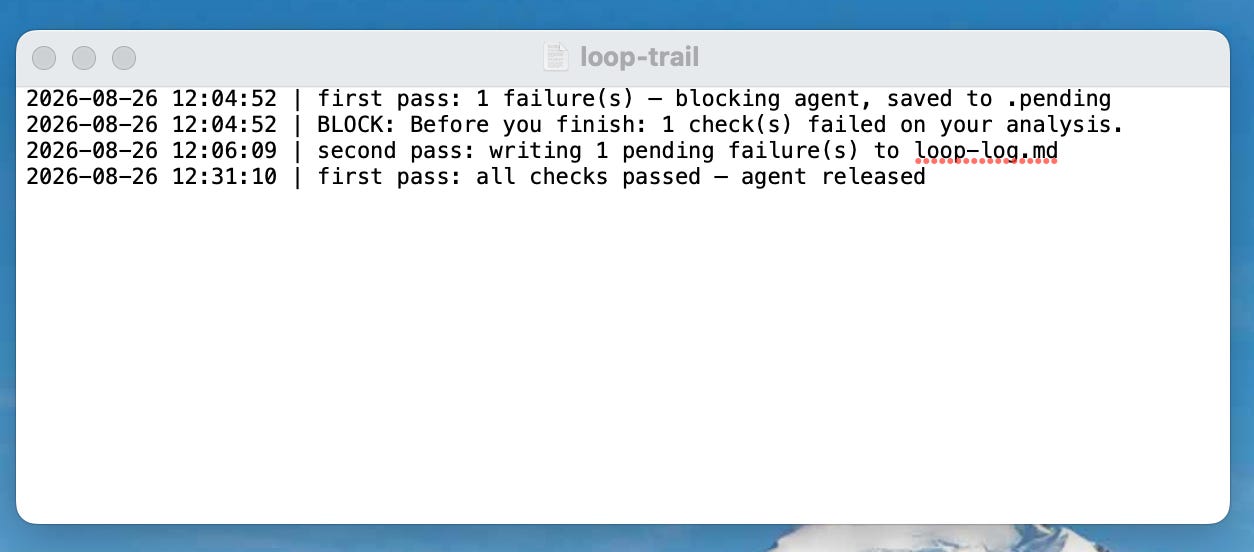
The third issue listed above is something nothing can settle for you automatically. Your checks catch what you thought to check. Everything you didn’t think of sails through looking perfect, forever, and no amount of green tells you otherwise. So read the output yourself sometimes. Not every run, but often enough that you’d notice something nobody ever asked it about.
“But the agent I’d want to set up to self-improve doesn’t do interviews.” This is just one example. You can swap it. Open check.py. The four checks are about sixty lines of ordinary Python near the top. Swap them for four questions about your own work that a script could answer. Everything else stays exactly as it is.
🏕️ BASE CAMP
What’s actually in a loop?
You need three parts at a minimum. If any one is missing, it’s not a complete loop. No exceptions.
Capture. Writing it down the moment it happens.
Your agent hands you something not quite right and you fix it. Rewrite the sentence, delete the paragraph, move on, because the fix took forty seconds.
I have done this hundreds of times. And every one of those forty seconds was the most useful thing that happened all day. But I threw it away. (Because I was oh so busy, too many other things to do to stop and think about how valuable documenting that might be!).
That’s all capture is. It’s keeping the receipt, putting it where it can be found and used. It has to happen on its own, because agents are terrible at last steps, and so are we. That’s the whole reason there’s a hook.
Something to measure against.
I gave a stripped-down version of my analysis agent a few thousand forum posts and asked what we should build. It came back confident and well-sourced, every quote real, with a product roadmap for a business I don’t own. Every instruction followed. It was no use to me at all.
But no simple “format check” catches something like “is this relevant and useful?”. So a really good self-improving loop needs two levels:
Check against the answer key — does this quote appear word-for-word? Catches wrong.
Check against the question that was asked — catches useless.
You can get full marks against the answer key and still have answered something else entirely. Ask me how I know. 😑
And neither one can be written by the agent about work it already did. Ask it to write a rubric for something it just produced and it’ll write one that passes. Of course it will. You would too.
Approval and a record (loop-log.md).
Nothing changes unless you say so.
I got this wrong first few times in the most embarrassing way: I let the agent decide when something deserved to be a permanent rule. It set both its own standards, told me I’d agreed, and wrote “decided with Caitlin” into a file. I’d said nothing! I hadn’t even been asked! Yikes.
So now I know, and I decide when it doesn’t get a vote, and how hard the stop is before updating anything. Typically, for agents with medium- to high-risk tasks, my self-improvement loops watch, writes things down, and that’s where the authority ends.
Everything ends up in one append-only file. It includes every failure, which ones it fixed itself in the outputs of the task (e.g. “I got that wrong, went back and fixed it”), and every rule you agreed to add in to newly improved instructions. Nothing gets edited without me in those cases.
A bit of troubleshooting for your future self-improving loops
I wrote a check that was wrong, and you might too.
The check said: every transcript in the folder appears in the output = correct. So as long as the analysis results included all transcripts that exist in the folder, the coverage was considered good enough.
This was reasonable-sounding, but the wrong metric. Teams analyze a subset of what’s in their data folders all the time. So if I told my agent to run on a subset of the interviews in my folder, the loop would go, “that was wrong! Incomplete, must be fixed!”
My loop was about to start failing good analyses, then proposing rules to make the agent better (that would actually be worse), citing failures that were not failures.
But the loop was technically working the whole time. It was functional. My definition of good was the broken part, and a loop can’t see or judge that.
How to get this right the first time (or at least really close).
Two questions, ten seconds each. Every time I create a new improvement loop with checks the agent’s improvements will be based on, I asked this:
What’s a good piece of work that this check would reject?
What’s a bad one it might let through?
It won’t catch every single thing, but it will get you a lot closer to writing checks to measure what will actually improve your agent.
I still think you can’t hand over that kind of task. You have to figure out that “what good looks like and passes” part yourself. Self-improving agents, both simple and complex, have to start there and it starts with you.
—
Keep moving.
— Caitlin