

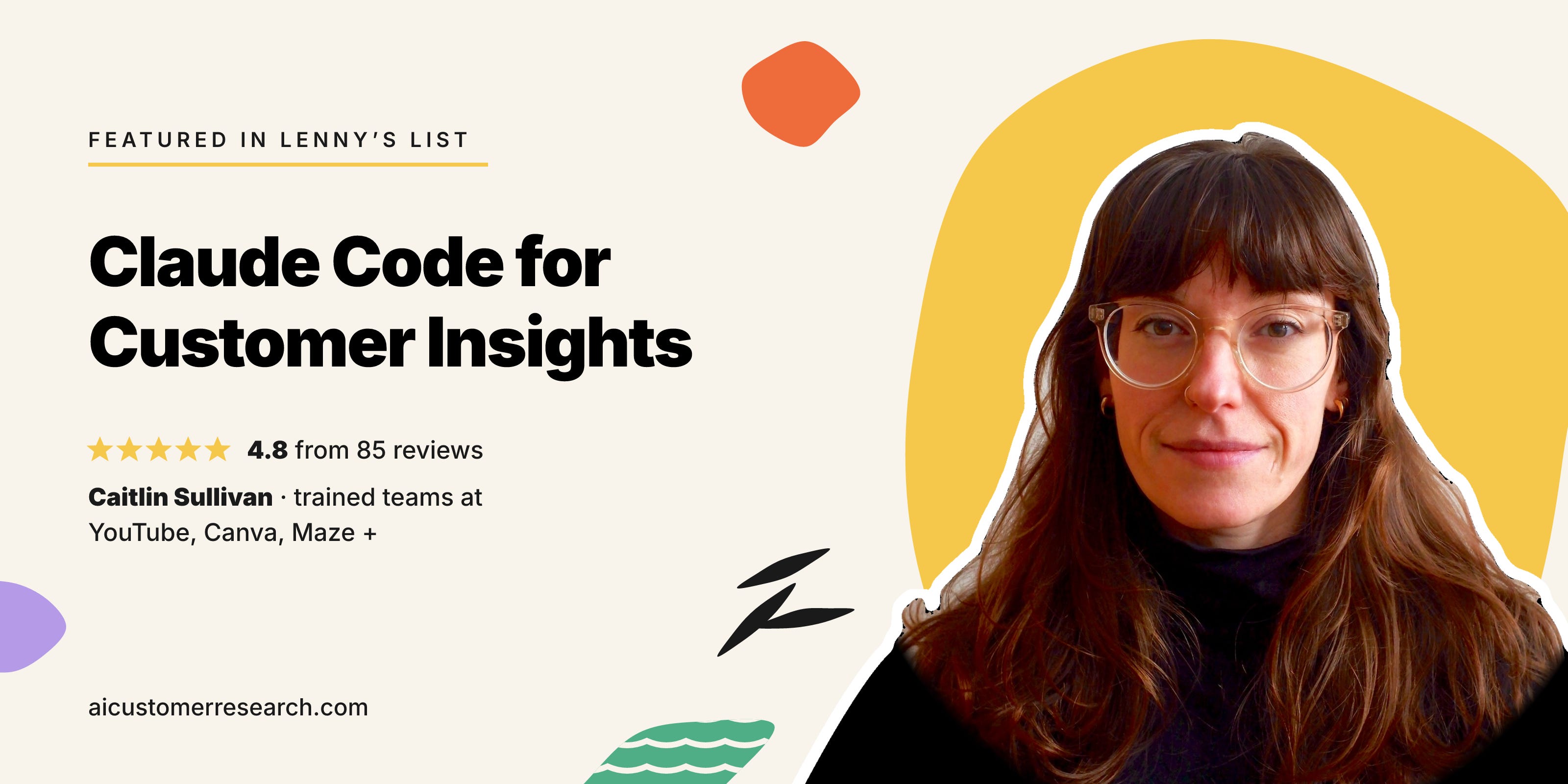
My Claude Code for Customer Insights course starts Monday, October 19. It’s likely the last live cohort of the year…
🎟️ Subscribers get 15% off this course 🎟️
Newsletter subscribers always get the best available discount on any course I run. Subscribe to get access to this and future insider-only offers.
Here’s why I think you should join us.
A year ago, most of the questions I was getting were some version of:
“How do I trust AI to analyze my customer data?”
But Claude can analyze customer calls, survey responses, tickets, reviews and other customer data remarkably well these days.
The harder question has become:
How do I get it to give me the kind of findings at the right depth we’re confident enough to build our product around?
I’ve worked with 100s of teams, and this part is still a challenge.
AI gives you a decent sounding answer very quickly. But if you haven’t given it the right context, methodology, standards and checks — including where your judgement needs to come in — you can end up with something that looks good without actually delivering the answer you needed.
I’ve spent the past six months iterating this course across multiple cohorts to solve that problem.
The course has evolved from building insights workflows for interviews and surveys to handling larger data volumes, scaling workflows across your team, and running evals on your workflows that test how well they’re actually working.
Don’t take my word for it!
The course is rated 4.8/5 from 85 students.
Here’s what a few of them said:
“I came in having built a dozen, individual Claude skills and left able to build real workflows to level up my work. It’s been a game-changer for how I work and how I support my product teams.”
— Kristin, Staff UX Researcher, Lyft
“This was a super informative course on how to use Claude Code for research analysis and workflows, including how to set up projects, creating skills of varying complexity, and all the steps you need to take to ensure data integrity and accuracy in your analysis. I feel a lot more confident now than I did before the class and I was able to apply what I learned immediately to my current work. Highly recommend!”
— Courtney, UX Manager and UX Research Team Lead, Octave
“The course is incredibly practical and Caitlin really focuses on making you make the most of it. The workflows we’re working on are complex, but you will end up with something you can use for your particular use case, and on top of all of that Caitlin shares a lot of her own resources as well.”
— Andrea, Product Manager, IDEXX Laboratories
How the course works
The course runs for a little over two weeks:
Week 1: Build
You'll set up your Claude Code environment, teach Claude how you work. Then you’ll build at least one real workflow you’ll actually use at work (usually a few), using your own data or the course dataset.
Week 2: Scale and test
You’ll make those workflows more reliable, connect them to your broader discovery work in more complex linked processes, and add evals to test whether they’re actually producing the results you want. Some students even start teaching the rest of their team how to iterate CC workflows together.
Along the way, you get:
Two live sessions with me. Both are recorded.
Two projects with my personal feedback, so you’re improving faster.
Lessons and files you can copy and continue learning from, including my own skills, CLAUDE.md files, demo project and review agents.
Daily replies to student questions in the chat.
About 6–8 hours/week for the core course.
Early access from October 12 - a bonus week to familiarize yourself before the cohort starts.
Course access is forever. And you don’t need to use company data if you can’t: practice with my dataset instead. Use the terminal or Claude desktop app’s Code tab for all of it, your choice.
Maven also offers a money-back guarantee, and many students get their course reimbursed by their employer.
So your biggest risk is getting to 2027 and still starting from a blank chat and one-off prompts every time you need customer insights!
〰️
Enrollment closes Friday, October 16.
Enrolling now gets you access to materials on October 12, before the cohort starts. I may take the course self-paced after this — it’s a final chance this year to get my personal feedback and support.
If you have questions, send ’em over. Hope to see you there!
— Caitlin
Oooh, looking forward to this!